

By Katharine Dorpman
Here are six activities I use regularly in my classes to practise a variety of grammar points using student-generated materials. All each student needs is a sheet of A4 paper, which they tear into eight pieces, and a little imagination. The materials they create are simple, effective, and reusable.
The activities require zero preparation from the teacher, and the students are more engaged as they create the materials themselves. They are also excellent for revision: my students are always pleasantly surprised when I bring the activities back in later lessons, giving them another opportunity to recycle and reinforce previously learnt language.
1. Collaborative Story
For this, you can prescribe the grammar they use (simple and continuous tenses, or conditionals work well), or give students free rein:
- Each student writes one verb on each scrap of paper giving them 8 in total.
- In pairs, the students make two piles of 8 face down on their desk.
- Student A turns over a verb and makes a sentence with it.
- Student B takes a verb from their pile, repeats Student A’s sentence and then makes a second sentence with their verb. The sentence must follow on to make a story.
- The students take turns to repeat the story so far and add their own sentence using the verb prompts, making this like an advanced version of the classic Road Trip memory game.
- After all the verbs are used, they work together to try to retell the entire story.
- Once they have told it aloud, they write it down.
As an extension, they can turn their written story into a gap-fill for another pair to complete. Alternatively, the story they make is only the first half – they swap with another group and come up with the end to the story.
2. Picture Prompts
This works well to practise using when or while with the past simple and past continuous for interrupted actions:
- Students draw one picture on each piece of paper. You can scaffold by giving them categories to limit their selection, e.g. an animal, a food, an activity, etc., or just let them freestyle, which is what I did here:
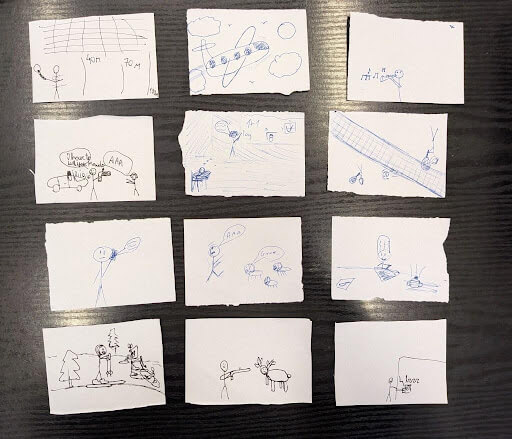
It really doesn’t matter what they actually draw – some go full artist and others do something basic or barely identifiable. Also, if they don’t really like drawing, they can just write something instead, e.g. ‘play football’.
- Collect and redistribute the pictures so each pair has 16.
- They turn over two images at a time and make as many sentences as they can using when and while, and switching the clauses/events around.
- For feedback, ask ‘What is your best/weirdest/funniest sentence?’
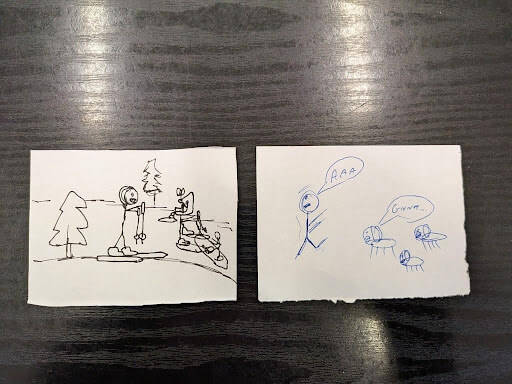
For example, with the two images above it could be something like:
Kevin was skiing when he saw the man and his dogs.
While Kevin was skiing, the dogs chased the man.
When Kevin stopped to enjoy the view, the dogs were chasing the man.
Kevin hid behind a tree while the dogs were chasing the man.
The more bonkers the better!
As an extension, they can combine their sentences to make a story and see who makes the most coherent/fantastical story. This could become a poster or comic project which they can then present and give each other feedback on.
3. Positive-Negative Table Slap
I last used this with the past continuous but it’d work for any grammar point where students are practising positive and negative forms. After covering or revising the grammar point you want them to use and tearing up their paper:
- On one side, students write a positive sentence using the grammar point e.g. My mum was baking a cake last night.
- Once they have eight, they swap sentences with a partner.
- The partner reads the positive sentence, turns the paper over and writes the negative version on the back e.g. My mum wasn’t baking a cake last night.
- Spread the sentences on the desk with the positive sentence facing up.
- Play table slap: students stand with their hands on their head, the teacher reads out one of the sentences, students try to find it, slap their hand onto the correct sentence on the desk and repeat it. Repeat this a few times with the students as the teacher (I find it works best in groups of four and they can do 3 or 4 each).
- Turn the papers over and do the same with the negative side up.
- Once everyone has had a go, repeat again but this time the teacher reads out the positive sentence and the students must slap the paper and say the negative version, or vice versa. Again the students repeat in groups, each playing the teacher’s role.
4. Snowball Q&A
This remix of a classic activity is good for practising ‘Whose xxx is this?’ with possessive pronouns, along with any vocabulary you want to revise:
- On each piece of paper students draw a picture related to whichever vocabulary you want to cover. We recently did furniture so the students chose 8 items and drew a chair, a bed, a desk etc.
- Screw each piece of paper up into a ball and put them in the middle of the room.
- Give students a one-minute time limit to have a snowball fight with the screwed up paper (my students often beg for two minutes but I find the maximum they can actually do is 90 seconds before they run out of puff!).
- When time is up, put all of the little snowballs back in the middle.
- Demonstrate the activity by picking up a picture, unravelling it and asking ‘Whose wardrobe is this?’ (or whatever is on the paper)
- In the first round, the student claims their picture back by saying ‘It’s mine’ or ‘It’s my wardrobe’ depending on your focus.
- Repeat and build up to ‘It’s yours’, ‘It’s hers’, or ‘It’s Wiktor’s’, etc.
- Students can also do some pictures together for ‘It’s ours/theirs’
5. Transformations Race
For exam preparation groups I like to collect key word transformation tasks (Cambridge B2 First, C1 Advanced and C2 Proficiency Reading & Use of English Part 4) over the course of the year. Students can come up with their own (challenging but doable, especially if focused on something specific e.g. I wish/if only) or they can just copy some from the book.
They write the activity on one side of their paper, and the answer on the other.
Once they have 8, they can switch with other groups and have a go at completing the transformation, alone or in pairs, checking their own answers by looking on the back. I collect them in and keep them, adding to them as we go throughout the year. You can bring them out periodically for warmers or for a fast finisher activity. If you have the option, it’s handy to laminate them for longevity.
For the race part, I get each pair to choose 8 at random and put them question side up in a row on the desk. They race against other pairs to work out the answers, checking their own answers as they go. If they make a mistake, they turn the cards back over and go back to the beginning. The first pair to complete eight transformations correctly wins. This could also be done with the cards around the room to include some movement.
6. Irregular Verb Pelmanism
I find Pelmanism and memory games are very effective in helping students to get to grips with irregular verb forms. I sometimes make the games myself, but the students can just as easily do it themselves, which also makes it more memorable.
- Each student chooses 4 irregular verbs and writes the infinitive on one piece of paper and the past simple form on another.
- Combine with another student so each pair has 8 verbs in total (or 12 if they are a group of three and you think they can cope).
- First, jumble them up and get them to match the pairs in two columns.
- Give the students 30 seconds to look at the list and try to remember them.
- Turn the first column over so they can only see the past form. Students then work their way down trying to say each pair correctly e.g. go – went, say – said, buy – bought etc., turning the papers back over as they go. If they make a mistake they go back to the beginning. I recommend instant feedback on pronunciation errors here as your students are going to say the same verbs several times.
- Once they make it to the end without any mistakes, they turn both columns over and do the same thing again.
- When they have made it all the way down with no mistakes, jumble the columns up and play memory – a student turns over one card and must say both forms, e.g eat-ate, then they look for the match.
- When they get a pair, I also get them to make a sentence or ask a question using the past form too.
You can do this as a three-card Pelmanism/memory game with past participles too. Everything is the same, they just need more paper.
Biography

Katharine Dorpman is a CELTA and YL-certified English Teacher, EAP Tutor, and Cambridge Speaking Examiner. She has taught in Malta, the Basque Country, and the UK, and is now based in Poland. Specialising in teaching young learners and very young learners, she is particularly interested in low-preparation, minimal-materials activities and using student-generated content to promote creativity and active participation in the classroom. She is currently working towards the Cambridge DELTA and regularly shares teaching ideas and reflections on her blog: https://teflkat.wordpress.com/


