

By Christopher Walker
We can thank the French for the word journey. They took it from the Romans, of course, but made it their own, and then we made it ours. Its original meaning is “a defined course of travelling; one’s path in life.” The French took the suffix -ée that also gave us soirée and matinée – the time made tangible by the addition of two letters. Then we changed the spelling, because that’s what we sometimes do.
Every day, then, can be considered a journey, and so the journey of our lives is long and full and ripe for analysis – which is what I want to do here.
The Journey of the Teacher
Let’s start with me and get that out of the way. This is my teaching journey.
I started in 2001, in Japan, for one of the big three. No qualifications were necessary – the qualification was your passport. I quit after two months when I started getting complaints from students who didn’t like that I laughed at my own jokes before they even managed to understand them. I served my four-month notice and left.
But I’d caught the teaching bug, if there is such a thing, and in 2006 I found myself in Kraków on a CELTA course. I did fairly well but my tutor warned me to take things more seriously. I didn’t, of course, until I started working at the same school that gave me my CELTA, and discovered I was in over my head.
A year later I moved to Bielsko-Biała, and except for one year spent travelling, I’ve been there ever since. I have been lucky – it is harder to recruit for a school wedged among the mountains than for one famous for gingerbread (I’m looking at you, IH Toruń) – and if I think of myself in those early years from my current perspective of Director of Studies, I wonder if I’d have wanted to offer myself a new contract every year.
After five years at the school, I was still getting by on my CELTA credentials. My DoS insisted I do Alex Tilbury’s Language Awareness Course so that I could finally add something to my CV. I approached it in my usual non-serious manner, even choosing to analyse High Valerian in the first unit instead of something sensible like French or German.
But then something clicked.
And I haven’t looked back since.
I did all the training I could. I have now done the Young Learners’ Certificate, the online teaching course, the teacher training certificate, the very young learners’ course (which my ageing body is glad not to have needed so far); I found the money to do a Master’s degree, and I’m considering the possibility of the DELTA. At my school, I started to take on more responsibility. I took charge of the computers for a few years, and then I was the Exams Coordinator. The DoS started to ask me to observe the teachers, and I started to go to conferences.
I had become a professional, at last.
So, what does all of this mean?
I look at generative AI and I see the future. A lot of the teaching we do could be done through AI, especially at the lower levels. AI will not get tired of correcting your mistakes at A1 or A2 level, and it can provide exam practice at higher levels. It can mimic human to human interaction in an exceptionally limited way, but when you’re a low-level student, you might not notice – or you’ll accept the diminished quality in exchange for vastly diminished costs.
The effects on the school will be this: fewer teachers will be needed, and of those that remain, the school will want to employ only those who are fully formed, professional, with five years of experience.
In the short term, that might seem fine. A team of experienced professionals? Great! No complaints from the students, and the life of the DoS will be made simpler as these professionals have already done all the CPD they want or think they need.
But within a few years, there will be real stagnation in the industry. Those experienced teachers might go part-time – or fully freelance, deciding the school acts as no more than a middleman. The school will then cast about for the next set of teachers with five years of experience, but where will these teachers be?
They probably won’t exist. This is the danger I see of losing students to AI. It will take out the bottom of the teaching market. To have five years of experience, you need to teach without experience, slowly accruing knowledge and the skills that can get you to the higher reaches of ELT. Schools need to take a gamble and hope it pays off, just as my school did with me. The teacher they promoted to Director of Studies is not the same teacher that they hired initially – except that he is.
I’ve spoken to so many teachers and institution leaders who see AI as the future. No – AI is the present, the perpetual present. The future? That’s the people we give a chance to, the teachers we take straight off the CELTA and help to develop. The future is human, but development is a journey of one day at a time.
The Journey of the Learner
Whenever I can, I like to take my daughters to school. We take the bus. The older one stares out of the window in a silence that shows remarkable resolution – but she’s fourteen, so what do I expect? The younger one likes to chat, and to play the yellow car game. Somehow she always wins.
One thing we never do is look at our phones.
You see the same people every morning when you fall into a regular habit. There’s always this one mother pushing a pram, and it disheartens me to see her two-year-old holding a phone, the light of the screen bouncing off her little face. I suppose this is the only way the mother has to keep the child quiet during the journey to preschool, and she’s certainly not the only mother who does this.
I sit by my daughter, listening to her complain about her English teacher (a story familiar to many bilinguals – the teacher sees my daughter as a threat, and seems to jump on her whenever she makes the slightest slip). I’ve heard the complaints so many times before, and without wanting to, my mind wanders. I think about the child in the pushchair clutching her mother’s phone, and I wonder about the journey this child is on.
If that child was encouraged to look out of the window, she would see more of the world around her. She would see the people going to work or to school – she would become a student of faces, and begin the long journey towards empathy and understanding.
She would begin to notice the landmarks in the city, such as they are – the big shopping centre cleaved in two by the road the bus travels down; the football stadium; the park with its fountain just visible between the trees. She would see the distant mountains and she would begin to orient herself in the city. If the worst should ever happen and she becomes separated from her parents, she will know where she is and where she needs to go to find safety.
But instead of any of this, she looks at the phone in her hands, this two-year-old child who is in no way unique in our modern world.
I covered a class of six-year-olds not too long ago. The classroom was quiet when I arrived, even though most of the children were already there. They were on their phones. When I set off on my teaching journey, every classroom I entered was already buzzing – the kids chattering or running about, the teenagers gossiping, the adults… well, all right, the adults always seemed exhausted even before we began. But the point still stands.
Phones have become increasingly central to all our lives, but as adults we can generally recognise when they are becoming too much. Young people have grown up with the phone in a way we can never truly feel, and so they lack this awareness, this understanding of what it is doing to them.
As teachers – as humans – it then becomes our responsibility to redress the balance. When I started out, I was a teacher of English and not much more than that. The job description has expanded, whether we like it or not. We are now the teachers of future humanity – it falls to us to help young people to learn all those things we once took for granted, because there weren’t smartphones when we were two and being taken around the city by our parents in a pushchair…
Our journeys make us who we are. Many of us have been lucky enough to have embarked without the incursion into our lives of technology, whether that is the smartphone or AI. But the pressures placed by technology on the development of the next generation are becoming too great, and from time to time we must remember the true nature of the journey – it is something that is only human, and is made up of what we do on each single day along the way.
Biography
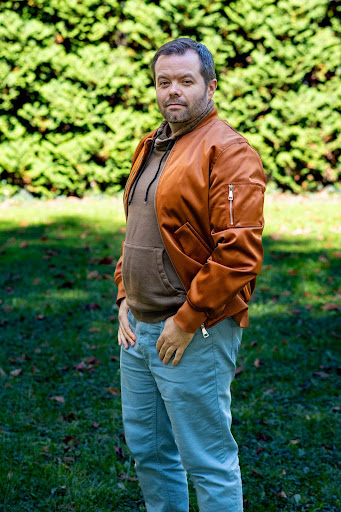
Christopher Walker is the Director of Studies at International House Bielsko-Biała, and also the Editor of the International House Journal. He has been in ELT for approximately twenty years and is still enjoying it.


