

By Daniel Tse
Oracy has attracted renewed interest in the education sector as it is considered a vital skill that benefits learners’ interpersonal communication and academic achievement (Oracy Education Commission, 2024). Whether EFL teachers realise it or not, oracy development is embedded in our current teaching practices to a certain extent.
How can EFL teachers develop learners’ oracy by using collaborative group projects? Before we explore two practical examples involving young learners and teenagers, let us first turn our attention to the concept of oracy.
Oracy
The term oracy broadly refers to listening and speaking skills. It was coined by Wilkinson (1970) as a response to the heavy emphasis on literacy – reading and writing skills – in English curriculum lessons. Wilkinson argues that oracy requires explicit instruction and that greater attention should be given to listening and speaking skills development. His definition of speech is broader than public speaking or elocution alone; it concerns the ability to articulate ideas effectively in interpersonal communication. He further suggests that teachers use “group situations” (Wilkinson, 1970, p. 75) to create genuine communicative needs in the classroom. Group projects, therefore, represent a versatile tool for oracy development as they give the learners ample opportunities to interact meaningfully and collaboratively.
One could be forgiven for thinking that oracy was merely a fancy term for listening and speaking. While contemporary EFL approaches to teaching language skills communicatively are closely aligned with Wilkinson’s vision, the difference lies in the idea that listening and speaking are regarded as inseparable targets for oracy development. In the learning aims of a group project, therefore, the target skills would be more suitably expressed in oracy terms, rather than in the form of separate listening and speaking sub-skills. This does not necessarily mean abandoning teachers’ modus operandi of setting the main and secondary aims of a lesson. We shall return to this implication for lesson planning in my examples of group projects.
Frameworks for oracy development
There are three published frameworks for oracy development by the English-Speaking Union (2023), National Literacy Trust (2024), and Voice 21–Oracy Cambridge (2019). The table below outlines the underlying skills of oracy in these frameworks:
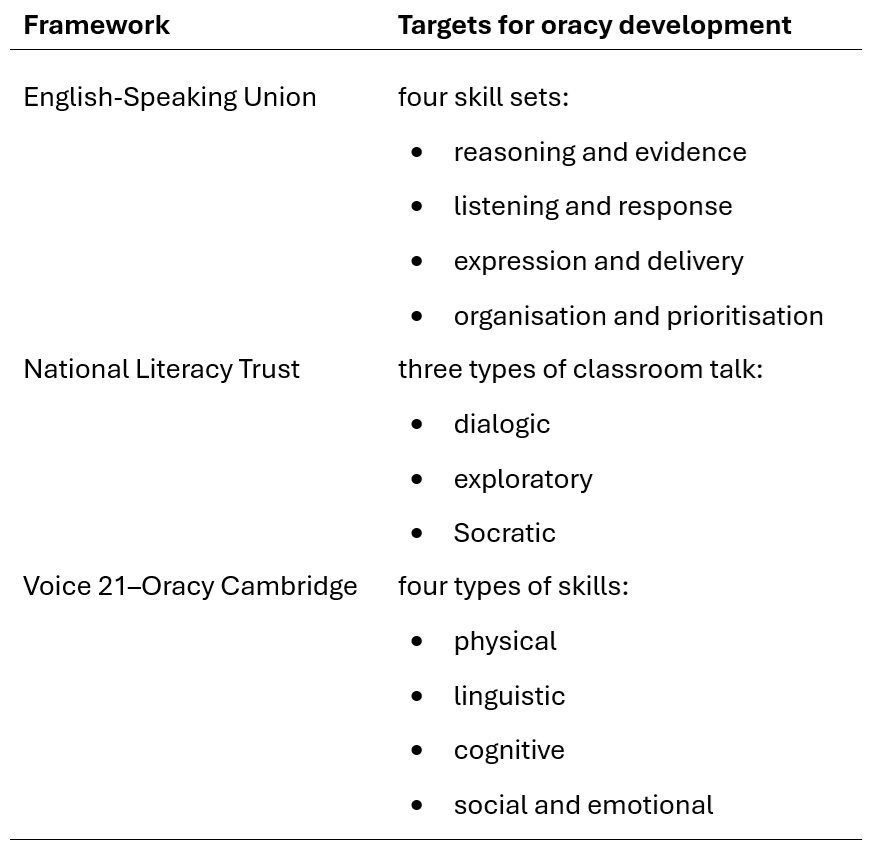
To provide EFL teachers, including myself, with a simplified overview of these oracy skills, I combined the three frameworks by using the detailed skill descriptions. By removing all function words (e.g., prepositions and articles) and subsequently grouping the remaining content words according to their referential topic, four themes emerge: general speaking, cognitive, communication, and social. These themes directly translate into four interconnected types of skills that underlie oracy. The table below shows my synthesis of oracy skills:
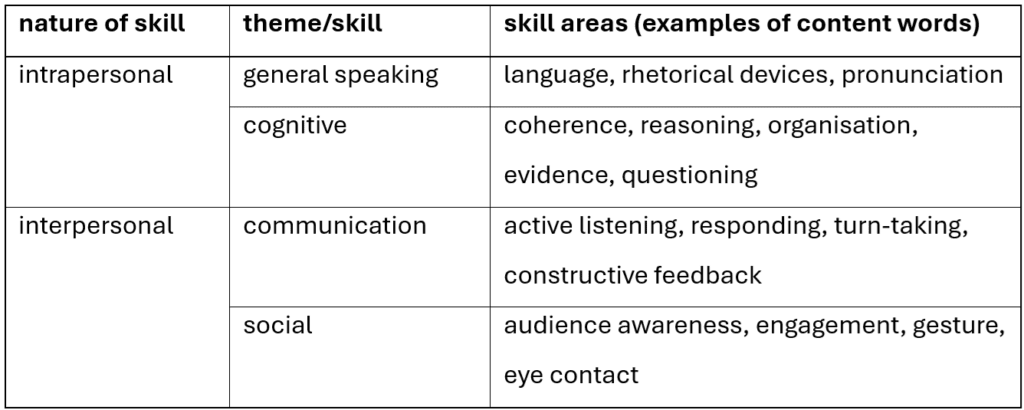
For the sake of simplicity, general speaking and cognitive skills are intrapersonal as their development is supported by the learner’s mental processes internally, whereas communication and social skills are interpersonal as they require the presence of other learners. In practical terms, teachers can target the individual skill areas in the learning aims of group projects. To ensure balanced development of oracy skills, the aims can focus on an intrapersonal skill and an interpersonal skill unless the learners’ specific needs demand otherwise.
Group projects
Looking at the various group projects I have tried, the most successful all follow a common procedure. This procedure has four general stages: setting up, preparation, presentation, and follow-on. The order of these stages is broadly similar to that in Anderson’s (2021) framework for project-based learning.
At each project stage, learners will use all four types of oracy skills to varying degrees, but teachers can choose to target two different skills in the main and secondary aims of a group project. Each aim usually applies to a single project stage, but there is flexibility depending on what the learners do. For example, they can develop their turn-taking skills across two stages by discussing the scope of their project (setting up) as well as various ideas for their presentation (preparation).
Project 1: Fusion food
The fusion food project involved ten teenagers at B1 level. The course syllabus was structured around themed projects rather than target language items. While the topic and assessment criteria of the project were fixed elements of the syllabus, I had some freedom to adapt the project deliverables. For the project, each pair of students was given two differentiated task options to choose from. They had to teach their classmates how to make three fusion dishes (option one) or explain the five dishes on their restaurant menu to customers (option two).
Based on my students’ learning needs, I decided that they should aim for a greater ability to develop and extend ideas coherently in the project. In oracy terms, therefore, cognitive skills were the target of the main learning aim; the secondary aim focused on active listening under communication skills (Table 2). To help my students achieve the main aim, I provided them with several guiding questions for each project option in the preparation stage:
Option one
- What are the ingredients of each dish?
- How do you make each dish step-by-step?
- Why did you choose to blend the original dishes?
Option two
- What are the five fusion dishes on your restaurant menu?
- What are the ingredients of each dish?
- Which of these dishes would you strongly recommend? Why?
I made the above questions available to my students as soon as they had decided on the project option. Learners who are more autonomous or more advanced can develop ideas first before the teacher’s intervention. When monitoring different pairs or groups, teachers can encourage their students to develop or extend ideas by asking one or more guiding questions as necessary. I have found some types of wh-questions more effective than other types in eliciting in-depth, extended responses. For example, how- and why-questions tend to work well as they prompt my students to engage in higher-order thinking.
Project 2: Time capsule
Towards the end of last school year, two separate Young Learner classes made paper time capsules in their final project. I had five fifth graders in one class and four more in another; their language levels ranged from A1 to A2. For the project, my students needed to discuss what objects they would like to put in their time capsules. Then each group of students had to describe the objects and, as an optional extension, explain their choices in the presentation stage.
Based on my classroom observation, many Young Learners are still developing their interactional skills in the final years of primary school. As my students had previously learnt how to make and respond to suggestions, I decided that it would benefit them to consolidate their skills in the project. This became the target in the main learning aim.
While EFL teachers refer to the target as a function or speech act, the ability to use the language involves listening and responding, or communication skills in oracy terms.
The secondary aim focused on the useful language for my students’ descriptions and explanations, which contributed towards their general speaking skills (Table 2). In relation to the main aim, most of the functional exponents below were elicited from my students:
Making suggestions
- Let’s + verb (base form)
- Maybe we could + verb (base form)
- Why don’t we + verb (base form) …?
- What/How about + verb (-ing) …?
Responding to suggestions
- That’s a good/great idea.
- Good plan!
- I’m not (so) sure.
- That’s a good idea, but …
No two classes are the same in their student-to-student rapport and learner autonomy. As you would expect, those in my first class took the initiative to use the functional exponents and kept their discussion going for several minutes. In my other class, I had to manage my students’ interaction and step in to restore the flow a few times.
Conclusion
There are different ways in which EFL teachers can develop learners’ oracy, one of which is using collaborative group projects. While the above examples from my classes are by no means a comprehensive account of oracy in practice, they illustrate how teachers can target the underlying skills of oracy in their learning aims. In fact, some of these skills overlap with EFL teaching and learning, such as functional language, active listening, and collaboration in group work.
If teachers are looking to incorporate oracy in their current practices, they can consider using collaborative group projects as a medium for oracy development.
Bibliography
Anderson, J. (2021). A framework for project-based learning in TESOL. Modern English Teacher, 30(2), 45–49.
Doherty, J. (2023). Why oracy matters: Evidence base for positioning oracy at the heart of the school curriculum. English Speaking Union. https://www.esu.org/wp-content/uploads/2023/11/Why-Oracy-Matters_FINAL.pdf
National Literacy Trust. (2024, September 18). Oracy and talk for learning. https://literacytrust.org.uk/resources/oracy-and-talk-learning/ (Original work published 2023, October 18)
Oracy Education Commission. (2024). We need to talk. The report of the commission of the future of oracy education in England. https://oracyeducationcommission.co.uk/wp-content/uploads/2024/10/Future-of-Oracy-v23-web-13.pdf
Voice 21. (2019). The oracy skills framework and glossary. https://oracycambridge.org/wp-content/uploads/2020/06/The-Oracy-Skills-Framework-and-Glossary.pdf
Wilkinson, A. (1970). The concept of oracy. The English Journal, 59(1), 71–77. https://doi.org/10.2307/811736
Biography

Daniel Tse works as a teacher and examiner in Italy. He teaches in-sessional EAP and general English at New Academy of Fine Arts (NABA) as well as other Italian universities in Milan and Bozen/Bolzano. He previously taught EFL at International House Milan and British Council for seven years. His teaching experience includes business English, exam preparation, CLIL, and topic-based ‘immersion’ courses. A DELTA-qualified teacher, he has worked with Young Learners, teenagers, and adults across the full range of CEFR levels.
In addition to teaching, Daniel has run teacher development workshops and spoken at ELT events in Europe for Macmillan Education Italy since 2024. He has also spoken individually at IATEFL conferences in the UK and British Council TeachingEnglish webinars. In 2024-25, he took on the role of CLIL teacher trainer, which involved running a full development course with lesson observation at an Italian secondary school. He has recently been approved as a tutor for International House Online Teacher Training Institute (OTTI).


