

Reviewed by Christopher Walker
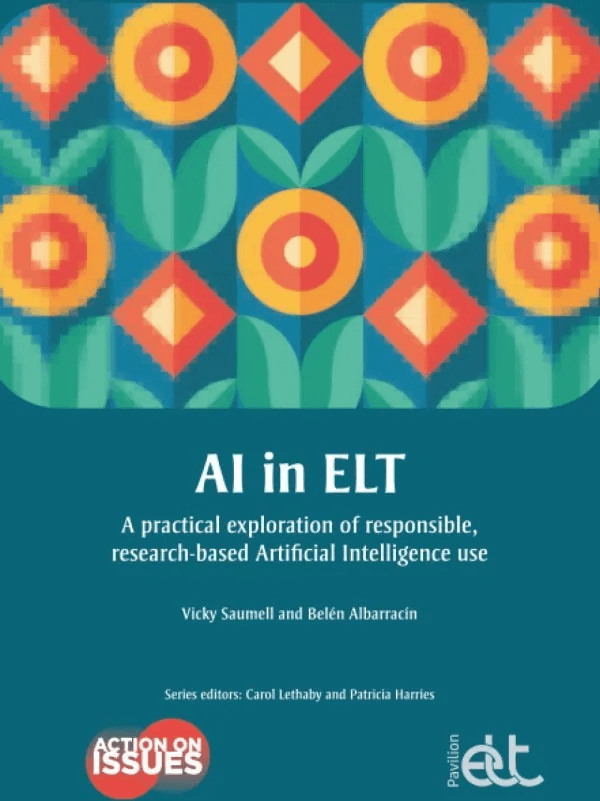
AI in ELT: A practical exploration of responsible, research-based Artificial Intelligence use, by Vicky Saumell, Belén Albarracín
You would think that books on AI would come with an expiry date on the back cover; you would also think it unnecessary or even unwise to spend money on a book that would soon be rendered irrelevant by developments in the technology it explores. But if you’ve ever read one of Pavilion ELT’s teaching guides, you know that won’t be the case – and AI in ELT is another example of the publisher knowing both what they’re doing, and what we in ELT want and need.
Part One: Identifying and understanding the challenges
The book is divided into two parts of six chapters each. The first part is less topical and thus the part of the book that teachers will be returning to five years from now. It explains what AI is, how it works, and what its operating model means – for instance, that hallucinations are not a short-term problem soon to be overcome, but something baked into the system. The second part is more practical and therefore more likely to be overtaken by developments – but there is material here that will see us all through the next few years at least.
Part One is an interesting read, the sort that you can sit down with and work through in order, rather than dipping in and out as you would with more practical guides. The first chapter delves into the inherent biases that GenAI works with and through – and that cannot be avoided, as GenAI platforms like ChatGPT are trained on massive quantities of human-made data that contain those biases and assumptions. This is something easy to notice if you’ve ever been on LinkedIn and started to wonder if everyone there learnt to write their posts at the same school – writing is more formulaic than many realise (a point often made by teachers of exam preparation classes to somewhat mitigate the challenge of the writing paper) and community members often end up writing in the same way as their peers. But it is important to know that this is likely to happen – and it should be a factor when we use GenAI to prepare classroom materials.
You’ll learn something new on every page in this section of the book – and soon you’ll feel like a student again, with terms in bold that cover the gamut from vector space representations to sentiment analysis. I feel wiser from my reading here; not only that, I feel that I’ll be able to teach some of these terms to my students (at C1 and above, most likely) when we next discuss AI. I like that – so often, the discussion is at a high level but the lexical challenge is absent; here, I can help my students sound like experts in the field, which is often what students want.
It’s not all pure joy, of course – this section is academic in tone and register and you’ll find yourself battling through bullet points like this one:
‘Shat et al. (2020) mention that ‘Yatskar et al. (2016) found that in the imSitu image captioning data set, 58% of captions involving a person in a kitchen mention “women”. However, standard models trained on such data end up predicting people depicted in kitchens as women 63% of the time (Zhao et al., 2017).’ (p27)
If such nesting of quotes isn’t your cup of tea, do consider yourself warned.
Another chapter considers the environmental impact of AI. When I first heard about it, the fact that GenAI requires so much water (or that it required any) was shocking; here we learn why, and how much is involved. To do my bit, no GenAI was used in the writing of this review; I did, however, get thirsty and drank about half a litre of water. According to my calculations – with the help of the book’s myriad examples – I am the better water investment. My hard work will be undone though if anyone runs this text through ChatGPT to get a fifty-word summary.
Some of the rabbit holes the authors journey down are particularly thought-provoking. I’ve long been fascinated by the bilingual brain, and in Chapter Four: Varieties of English and multilingual representation, the same terrain is explored through the lens of AI – showing that students who use AI and whose first language is not mainstream and easily parsed by the Language Learning Models that feed GenAI, should be particularly careful of what they are told by the likes of ChatGPT.
I could go on and on about the things I learned in that first part, but soon my review would be as long as the book itself. On, then, to the second part, and the practical applications of GenAI.
Part Two: Practical solutions and strategies
This is where the use of AI differs so much from everything that came before. I do not remember a resource book full of practical tips that required a whole chapter’s worth of guidelines about making responsible use of the advice about to be shared. I certainly wouldn’t expect a warning that the use of third conditional could dredge up traumatic experiences in a book of grammar games; but warnings like those here are worth following. I have begun to worry considerably about things like cognitive debt – the idea that letting something else do the thinking for you now means that you won’t be able to do the thinking for yourself later – and so, please, do not skip this chapter, however eager you are to get to the ‘good stuff’.
A lot of the chapters that comprise this part of the book deal with literacy – particularly AI literacy, but with an overview of what we understand by the term in the first place – and the responsible and informed use of AI by both teachers and students. If you’re looking for the perfect prompt to generate a worksheet or a word search for your students, this is not quite the book for you – but I doubt you’d be looking for such a book in the first place. The reflective, discussion-based activities here are much more valuable, and will help everyone in the classroom better understand what they are doing when they do anything with GenAI.
Chapter Nine is packed with ideas to make effective use of GenAI. I would be a little careful with some of them. For instance, the book includes an example grammar explanation task that gets students to go to ChatGPT for an overview of a particular grammar point. Considering the discussion of bias in the first part of the book, some teachers will find this guidance a touch wayward – I certainly would, as I belong to that cult of teachers that believes there is no such thing as the future simple. To many of us, will is just the present form of the modal verb, with would as its past form. ChatGPT won’t see it that way because the LLMs it is built on see will as the future simple in the majority of online grammar explanations, and since ChatGPT doesn’t actually think for itself, it will just go with the majority view.
That said, the guidance is generally good – and easy to follow, regardless of your chosen AI tool. Some of the ways that I have used GenAI are touched on here. One very good use of GenAI is to perform tasks that would take far too long to do by hand, or that would be an overwhelming mental challenge. For example, I recall a time a few years ago when I worked on some B1 Preliminary writing tasks. I spent an hour or so writing three versions at a time in response to the same rubric, trying desperately to keep all of the assessment criteria constant besides one – so the three texts would have the same Communicative Achievement, Organisation, and Language, but would differ in terms of Content. Then I tried to do the same, but with the next criterion. It was exhausting, but very useful – as it highlighted to my students how each criterion worked, while also giving them something to discuss with their partners. I couldn’t imagine doing the same at B2 level, let alone C1 or C2; but with ChatGPT the whole thing becomes something of a breeze – until I run out of free prompts for the day.
Conclusion
AI in ELT is a long book – nearly 300 pages long, and most of it is content, as the References section that runs for the last ten pages is all in a microscopic font. It will take a long time for you to read through it all as carefully as it deserves to be read, and it will take a long time for you to use all of the activities it suggests. For me, that’s the measure of a good resource book, and so this one I am more than happy to recommend.


