

By Amy Gowers
It was Jane Austen who said, “It is a truth universally acknowledged, that a single teacher in possession of a good class, must be in want of a warmer” – or at least I think that’s how it goes.
Being a good teacher means being adaptable, passionate, and creative. It also helps to have a bag of tricks, and in this article I’m here to share with you 5 of my most successful and useful low-prep and gradable starter activities.
1. Alphabet Decoder
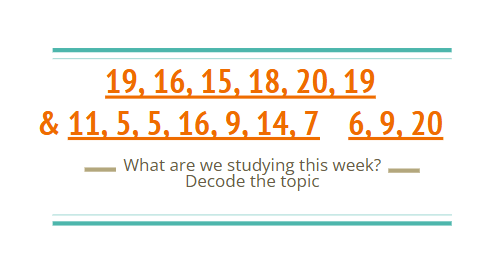
I choose Alphabet Decoder as the first starter as it’s my all-time favourite. Take a question or topic and change the letters to numbers e.g. A =1, B=2, C=3 and so on. The learners can then work together or in pairs to decode the numbers back to their original phrase.
The example image shows the simplest code in action. First, I elicit the alphabet from the students, writing the letters down the side of the board as we go. I’ll then draw their attention to the slide and ask for the first number (19). Again, as a class, we’ll count along the alphabet until we hit number 19, which is S. I typically repeat this 2 or 3 times just to ensure they understand the mechanics of the task. Then in pairs or small groups, they do the same with the rest of the numbers. Higher-level learners may not need to have the alphabet written in front of them but I would always encourage this, especially the first few times.
This task is very useful for drilling spelling bonds and knowing which letters are commonly used in tandem. For example, take the image above; the last 3 numbers spell fit. If learners miscount and end up with fjt, the teacher can draw their attention to this error: F and J are not commonly used together, so ask the learners to look around the letter J and see if there’s another letter which would be better.
Once the text has been revealed, the teacher can use it to spark a conversation between learners, which can activate schemata needed for the rest of the lesson. For the example above, I would ask the learners what sports they know and what ‘keeping fit’ means.
2. Low Stakes Quiz
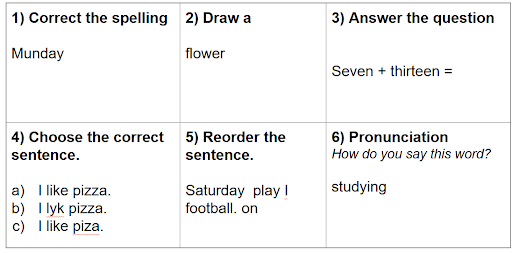
Create a grid (as seen in the image) and assign a simple task to each box. The learners will either work together or alone to think about and answer the tasks. Examples of tasks I use are:
- Draw a ….
- Correct the punctuation
- Five + seven =
- Correct the spelling
- How do you pronounce …..
The aim isn’t necessarily to test the learners but to activate their English and problem-solving skills. Having the same type of task in the same box each time they interact with the task allows learners to focus on the question itself and not get wrapped up trying to understand the instructions or question type. I always have a spelling problem in box 1, a drawing task in box 2 and a maths question in box 3.
Employing a mixture of question types keeps the activity fresh and interesting, and knowing that it isn’t a test or assessment puts the learners at ease.
This task does take some preparation the first time it’s used as the teacher needs to create the grid and input the questions before the lesson. However, the following time it’s used only the questions need to change. If I’m short on time, I’ll often keep some of the questions the same, especially if it’s a question the learners struggled with the first time round.
As with Alphabet Decoder, the learners need to be taught how to complete the task. Once the learners recognise that the question types stay in the same place and understand the instructions, they can be left to work independently. Follow this with a quick feedback stage, and then head into your lesson content!
3. Draw & Doodle
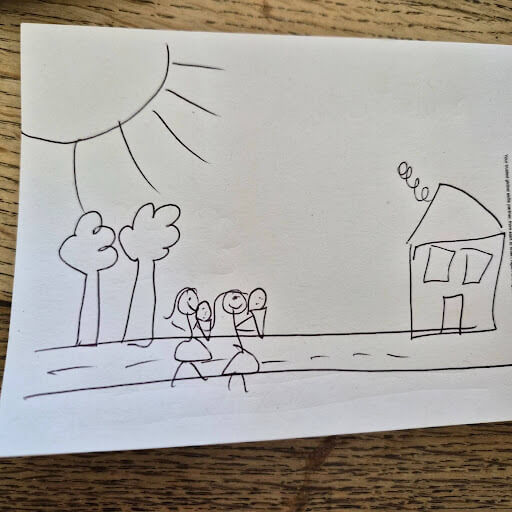
Ask the learners to draw a picture of something connected to them personally; it could be their weekend, the food they’ve eaten recently or their favourite room in their house. Here is a drawing of me and my friend walking home from the park with an ice cream. Once the picture is finished, learners can share what they’ve drawn with each other. Some learners may only be able to discuss their pictures at vocabulary level for example: play football, nice family, swim, whereas some may be able to describe the picture as a whole: “It was a sunny day so I went swimming with my family. My family is nice.”
Why do I count this as a warmer? I have taught my students the name of the task, and so when I need a few minutes to get set up for the lesson, or if there are students in the class waiting for the lesson to begin, I can put the name on the board, hand out some scrap paper, and let them get on with it – and this means we start the lesson running.
To extend this task, draw the learners’ attention to each other’s pictures. Have they drawn the same thing? Did they both have pizza for lunch yesterday? Encouraging them to be observational and curious can lead to more meaningful communication.
Art is a great asset to the ELT classroom; it can encourage communication, confidence, and creativity, while also aiding the development of narrative building and sequencing skills.
4. What 3 Words
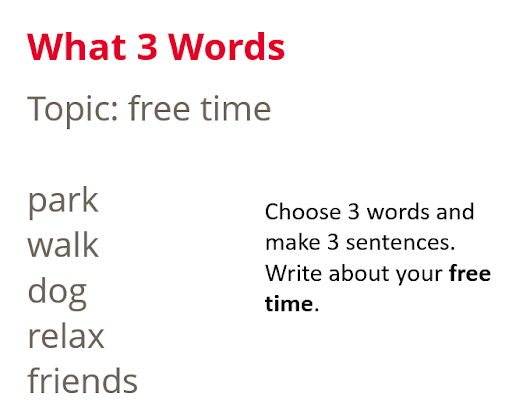
Give the learners 3 words and ask them to make sentences or questions using the words. Make sure you provide a context – if the task is too open-ended, you won’t be able to do much with the sentences, and it’ll also be harder for your learners to know what to write.
There’s a lot you can do with what the learners produce. If they write three sentences, you can see if they can combine them into one long sentence; or they can practice turning those sentences into questions for a quick discussion or mingle activity before you jump into the lesson. With the choice of topic, you can opt to make this a review of recent material, or you can use it to activate schemata ahead of the lesson proper. And if you have students who are good at handling responsibility, you could hand the whiteboard markers over and let them choose the five words that go into the task.
5. Flashcards Games – What’s this?
This is one I use when there has been a break in the regular course of lessons – maybe after a test, or one of those school holidays that dot the calendar between the start and finish of the year.
It’s a simple activity, but learner-centered and good fun. Put your students into small groups and hand out flashcards to each – but make sure they’re only using flashcards they’ve encountered before.
The students place the cards face down, and the first student picks one up and asks the group members to say what the card shows. It’s as simple as that in its basic form, but for variety you can also put some questions on the board that the ‘teacher’ can ask:
“What is this?”
“Can anyone tell me what this is?”
“Who wants to tell me what this is?”
This then becomes sentence-structure learning by stealth, and you can do the same at the transition, when the ‘teacher’ role is handed on to the next student.
Conclusion
As with all activities and tasks set in the classroom, there is a balancing act between familiarity and excitement. We don’t want to bore our students with overusing a starter but we also don’t want to waste input time with constantly teaching and explaining new activities, which is why I tend to cycle through my bag of tricks every few weeks. All of the starters can be levelled up or down to match what your students can do. And who knows? Some of them could even become the backbone of the lesson you’re about to teach. That’s the real joy of having a bag of tricks – you never know how or when they’ll come in handy!
Biography

Amy Gowers has been teaching ELT since 2010, and her work has taken her around the world physically and virtually. After saying a sad farewell to IH Bydgoszcz in 2019, Amy’s teaching has focused mainly on ESOL learners and helping refugees and migrants settle in the UK through language lessons. She is passionate about CPD and upskilling and believes that teachers should remain up to date with and inquisitive about their practice.


